Thursday, October 19, 2017

Day Twelve: Berlin and Bonhoeffer, Part 2
Day two in Berlin and the last official day of the doctorate class. Our focus is on Bonhoeffer as we go to the State Library of Berlin Archives where we have an appointment to look at original documents pertaining to Bonhoeffer’s life. We saw original pictures of him with the confirmation class that he led.

A picture of him with his colleagues at Finkelwald. This was an illegal seminary outlawed by the Nazi’s in which seminarians lived together in Christian community. This is the community that Bonhoeffer’s book Life Together is based on. He is in the second row on the far left.

We also saw his original last will he wrote from prison on September 20, 1943 with his signature at the bottom.

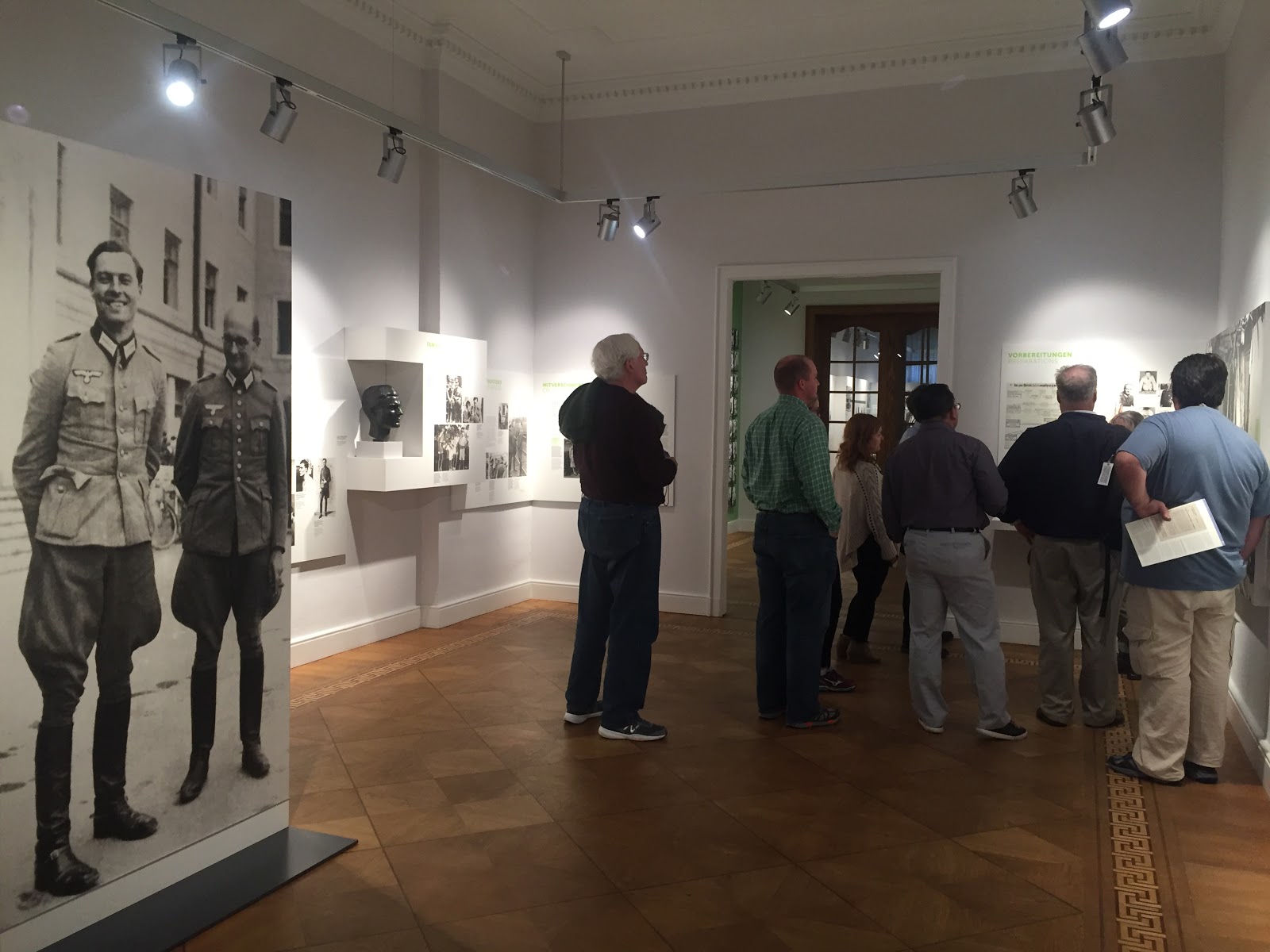
Then we went to the German Resistance Museum. We learned there wasn’t one organized resistance to Hitler, but rather lots of small ones that all made their impact. The most interesting story was the assassination attempt Bonhoeffer was involved in. Bonhoeffer’s role was to use his connections to tell the British government about the plans for an assassination followed by a new government. He was asking Britain to recognize the new government when it was established to gain legitimacy. But there were many others involved in the attempt. Here is a wall of their pictures.

Overall 150 people died because of their involvement with the attempted coup and assassination on July 20, 1944. Stauffenberg was the man who had the connections to put the bomb near Hitler. He is on the left of this picture.

This was the room were Stauffenberg’s office was and where he planned the specifics of the attack.
This is one of the meeting rooms Hitler used to stay abreast of the military updates.

It was at another location where all the top Nazi officials were, including Hitler, when the attempt took place. Stauffenberg hid the bomb in a suitcase. There were originally two bombs but at the last minute they changed the time of the meeting and he only had time to prepare one of the bombs.
He put it in a briefing room underneath the table where Hitler was standing and then found a reason to leave and watch from a safe distance away. Unfortunately, someone had moved the briefcase before the bomb went off and the huge oak table shielded Hitler. Stauffenberg thought he had succeeded and many miles away in Berlin, a coup was simultaneously taking place. Both attempts failed. This was the room after the explosion.

Bonhoeffer struggled with the moral and ethical dilemma of being a Christian and plotting to kill another human being. How do you reconcile “thou shalt not kill” and love your enemies with an assassination attempt? After all, he took ordination vows as a Christian minister here at St. Matthew’s Church.

A plaque to Bonhoeffer commemorates his ordination.

Other than that it is a normal Lutheran church…

Except that this painting looked vaguely familiar. Do you recognize it?

How about if I now show you Cranach's painting?
 
The Berlin Philharmonic was playing tonight but the concert had been sold out for awhile. Our professor went to the ticket booth that afternoon to see if there were any tickets…and there were! The two hour concert was incredible. Three pieces were played, beginning with Mozart and an amazing pianist, Mitsuko Uchida. The other two pieces were more contemporary artists, William Walton and Zoltan Kodaly. Sir Simon Rattle conducted these incredible musicians. Overall it was a magical evening with beautiful music!

We celebrated the end of our time together with a great German dinner, and of course…beer! Dr. Kevin Park and Dr. Kathy Dawson were great leaders.

I learned so much from this class: the places, the tour guide, the professors, and my fellow students. The Reformation has come alive and it’s been a joy to share these experiences through blogging, sermons, and a lunch presentation at King’s Grant on October 29. I feel I have a much deeper understanding of my Reformation and Presbyterian roots. Reformation Sunday, the last Sunday of October every year, will forever be a special time to celebrate my newly formed spiritual heritage.

Wednesday, October 11, 2017

Day Eleven: Berlin and Bonhoeffer, Part 1
Our Columbia Theological Seminary group of 14 left the Lutheran group of 15 and headed back to Berlin. It was about a 2 ½ hour train ride.

Our focus now shifts from the Reformation to Bonhoeffer and the Nazi Regime. After lunch, we only had one event planned, a visit to Topography of Terror. This new building is located on this site where the most important institutions of the Nazi apparatus of terror and persecution were located between 1933 and 1945: the headquarters of the Secret State Police (Gestapo), the Reich SS Leadership and Security Service (SD) of the SS and, from 1939 on, the Reich Security Main Office. The original building was intentionally destroyed because of the awful things that happened there. But a new building was built to remember and learn from the past. There aren’t many pictures to show you. The day was spent learning about how Hitler deliberately decreased the freedoms of the people, eventually erasing the line between police and party. It’s like if the Republicans or Democrats taking over the army and all local police.
      He passed many laws, for example in 1933 when all those with a Jewish heritage had to leave any position in public service: military, judges, teachers, etc. In 1936 a law was passed that anyone can be arrested or detained without a judicial review. Opposition to the government was banned which then led to many of the arrests. Concentration camps were forced labor camps to intimidate, humiliate, and break peoples spirits. Most were let out after a certain period. The Jewish people were the minority in the concentration camps. Extermination camps were part of the Holocaust and created to kill on a mass scale. Especially toward the end of the war, most of the Jewish population were sent here. The progression led from being arrested, either for owning a banned book, speaking out against the government, or having a Jewish heritage among other crimes, then being sent to a prison or concentration camp, and after a period, either being released, sent to an extermination camp, or staying in the forced labor camp.
     This is exactly what happened with Dietrich Bonhoeffer.
He was arrested, then sent to Tegel Prison, then Buchenwald Concentration Camp for 7 weeks, and then to the extermination camp at Flossenberg. It was sobering to see the systematic way Hitler eroded the freedoms of the German people, all in the name of making Germany a great nation again.
A special exhibit as on display about how Martin Luther’s words were used by both the Nazi regime and the Resistance.

The Regime saw Hitler as completing or carrying on Luther’s work: both being great German leaders, saving the people, and speaking out against Jewish People.
The Resistance used Luther’s words to speak about standing up to the powers of this world, being free in Christ, and following the Bible and God alone. These words are from Martin Niemoller and Dietrich Bonhoeffer…


      Topography of Terror is located next to the Berlin Wall. This time I was able to get up close to it and even touch it.

The top is rounded which made it impossible to get a grip on it should you try to climb it get over. Then you’d have to face the barbed wire, spikes on the ground, land mines, and guards if you were going to make your way to freedom.

On a lighter note, there are Berlin Bears all over painted in different ways. It added a fun and festive atmosphere to an otherwise serious, drab, dreary day. Here is the one at the US Embassy.
The one in front of the Blue Man Group.

And a fun one, just because!

Then there was the Grimm’s Hotel room I was in. Anyone want to guess which fairy tale story my room was?
Day Ten: Eisenach and Wartburg
In Eisenach, we once again find the intersection of Bach and Luther. Their paths crossed, albeit 200 years apart, in Leipzig, then Erfurt, and now Eisenach. As our guide pointed out: Eisanach and Bach, the two names rhyme no matter how you say it.

We started with the Bachhaus. Bach was born in Eisenach and lived in this house.

He was baptized at St. George’s Church in 1685. This is the original baptismal record from the church.
This is the baptismal font where he was baptized.

This is a replica of the piano instrument he would have grown up with.

As well as the actual family Bible of the Bachs.

Bach came from an extremely musical family, so you could say music was in his blood. In fact, if you look at St. George’s list of organists, you will see 4 Bach family members listed from 1665-1797. What a legacy!

The museum had great pods to sit in and listen to his music.

And what do you know, they have a special Reformation exhibit about Bach and Luther. Bach set many of Luther’s text to music.

We even had a special 25 minute samplings of 5 piano-like instruments that were played during Bach’s time. Isn’t it interesting how all the keys are black? Anyone know why? (Hint: It has something to do with the color of gloves they wore.)


OK, back to Luther. So Luther was sent from Mansfeld City to Eisenach for high school. He studied Latin here for three years until he went to Erfurt for college. During high school he sang at St. George’s Church and later came back to preach here, after being told not to preach anymore by the pope after the Diet of Worms.

Of course, like everywhere else, there’s a statue of him.

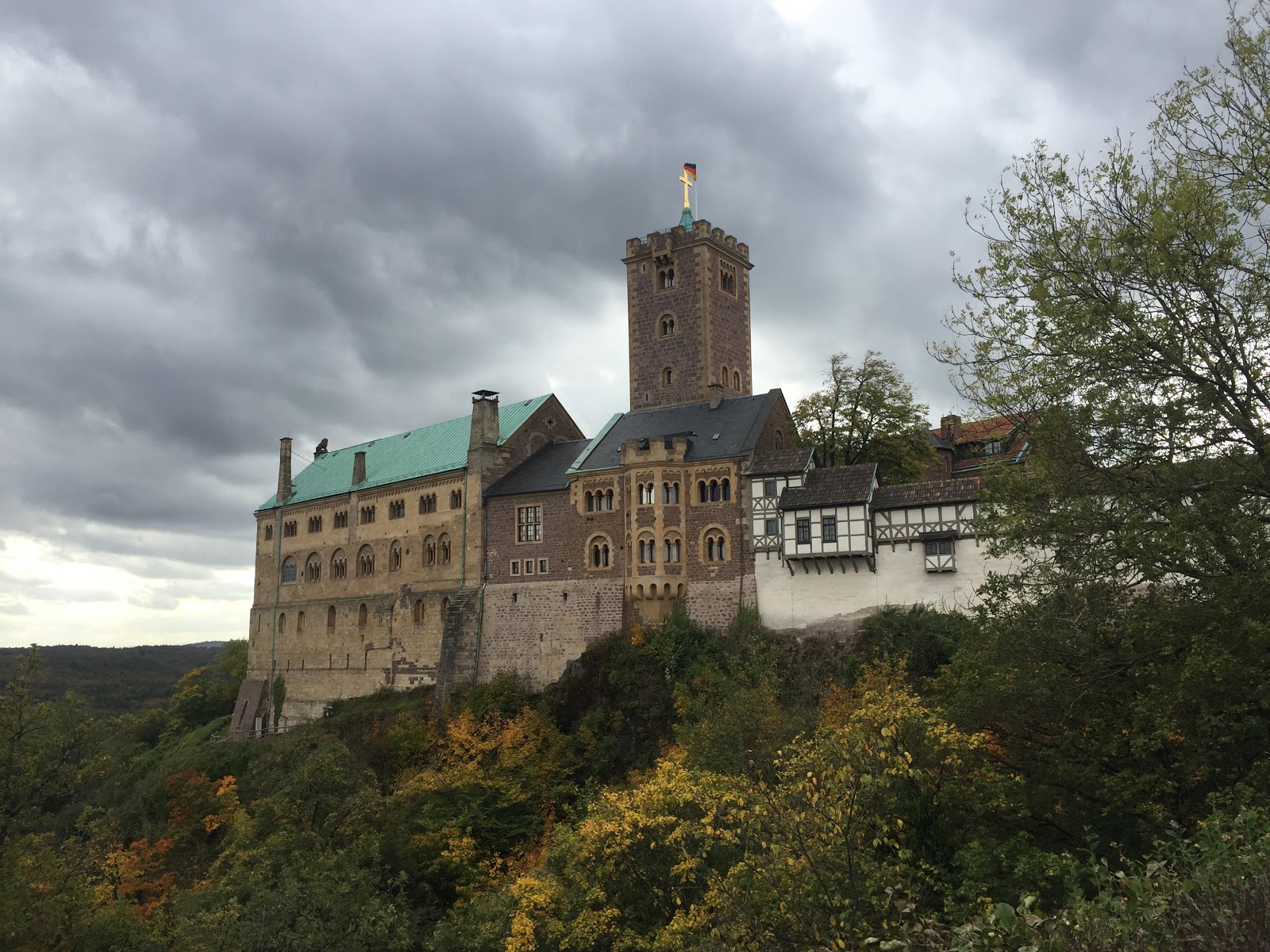
But the main highlight of the day was Wartburg Castle.
Luther lived here for 10 months after he was declared an outlaw at the Diet of Worms. He was on his way back from the Diet when he was kidnapped. Maybe in an area like this.

What he didn’t know, is that his protector, Elector Frederick the Wise had ordered the kidnapping to keep him safe. He was taken to this castle for safe keeping.

Now, when I think of castles, I think of cold, dark, and dreary. What a surprise to see a room like this.

In fact, it was a beautiful castle with several rooms and terrific views.

The best part was at the end. This is the very room that Luther spent most of his ten months. At his friend’s, Melanchthon’s, suggestion, Luther translated the entire New Testament in under eleven weeks! The desk and chair are not authentic but that white thing on the ground is!

It’s a vertebrae of a whale and Luther would use it as a footstool while he was writing and translating. The Bible is said to be his actual Bible with handwritten marginal notation.

The painting is an original Cranach. Interesting story about this painting: Cranach was Luther’s dear friend from Wittenberg. Nobody knew where Luther was during these 10 months of hiding in order to protect him and them. He even took on a new name: Junker Jorge (Knight George). Now you see the connection between Luther’s alias and the church in Eisenach. Anyway, Cranach was asked to paint Junker Jorge so he went to the castle. As the story goes, he painted Luther and had no idea it was him! Luther looked so different. Here are three Luthers: Monk Luther, Scholar Luther, and Knight George Luther.
Luther’s greatest achievement was his translation of the New Testament from Erasmus’ Greek and Latin texts into German. But not just any German. He translated it into a language that became the basis for the German language today. Back then, many different regions spoke different dialects. In his translation, he unified the language and in fact, many phrases are used today that he coined, nicknamed Lutheran German. After it was edited by Melanchthon, the first 3000 books printed in September 1522, sold out quickly.

 Luther did some more edits and a December edition came out a few months later. Talk about a best seller!

What happened that caused Luther to leave? He was still an outlaw which meant anyone could kill him with no fear of being punished. Luther heard that riots and iconoclasm was taking place in Wittenberg. The people started smashing church statues, stained glass, paintings and altars. Luther had to put a stop to it. The Reformation was getting out of the control. So against  the wishes of his friends, he returned to Wittenberg to try to get the riots to stop. But I have to stay, if I had to be in exile for 10 months, Wartburg Castle isn’t a bad place to be!